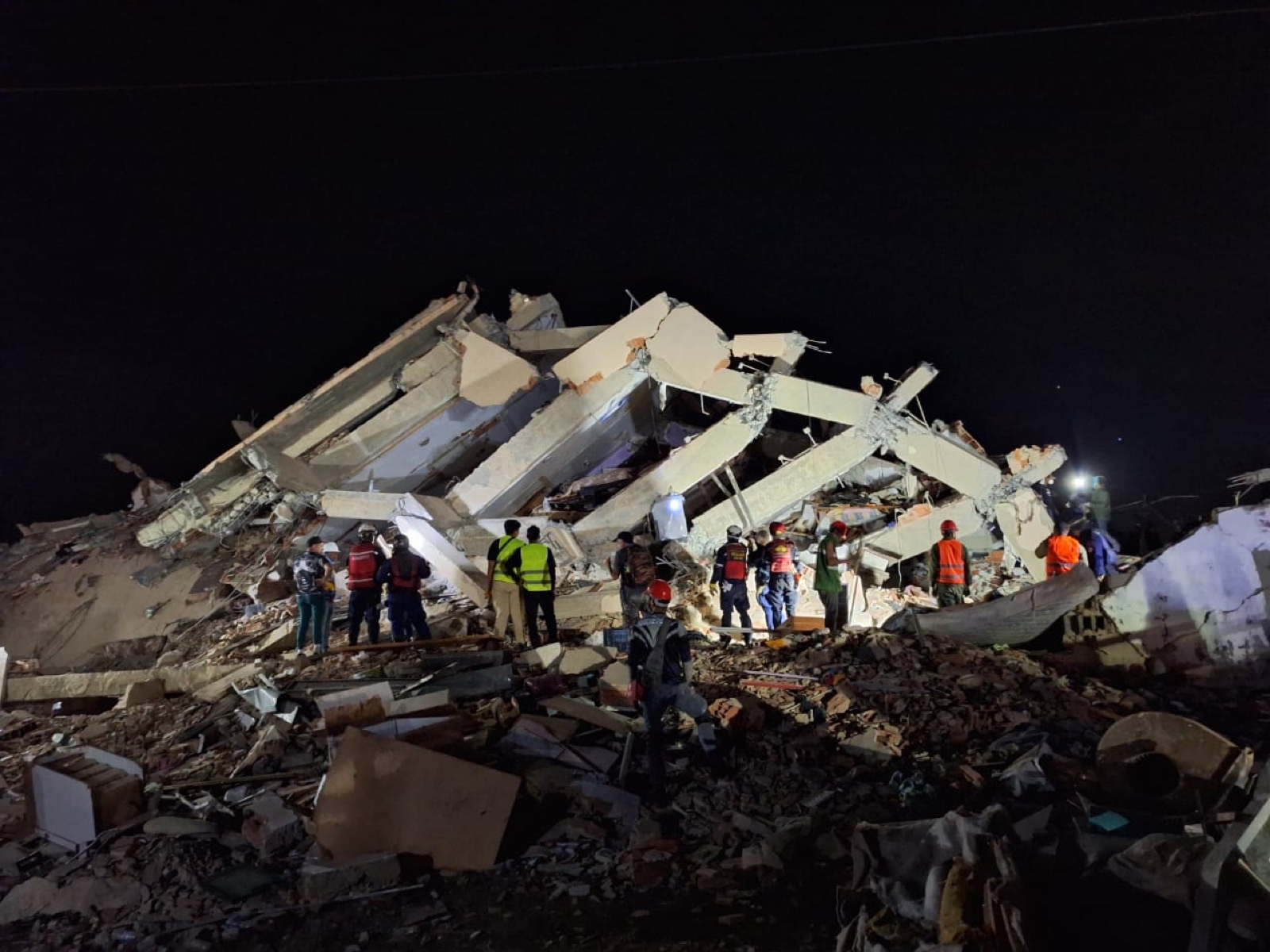
What Happened on 24 June
On 24 June 2026, the Battle of Carabobo holiday, at 18:04 local time a magnitude 7.2 quake struck with its epicentre on the San Felipe, Yumare, Montalbán axis in Yaracuy. Thirty-nine seconds later came the mainshock, magnitude 7.5, centred 17 kilometres west of Catia La Mar, off the coast of La Guaira.
It was reported wrong at first, so it is worth pinning down: the mainshock was not in San Felipe. San Felipe was the foreshock. The 7.5 struck off La Guaira, which is why La Guaira, not Yaracuy, was devastated. The correction comes from the USGS, cited by OCHA.
Both were strike-slip events. Intensity reached IX on the Mercalli scale, the strongest in Venezuela since the San Narciso earthquake of 1900. More than 600 aftershocks followed. Worst hit: La Guaira, the Capital District and Caracas, Miranda and Aragua.
The Figures, Each With Its Date
All of them are still moving. None is published here without the date it was given and the person who gave it.
As of 10 August 2026, 483,525 tonnes of rubble had been cleared, 16.51% of the 1.2 million tonnes the UN estimated on 21 July. Economic damage is disputed: $6.7 billion (UNDP), $19.6 billion (World Bank), $37 billion (UNDRR).
- 6,301 deadAs of 10 August 2026
- Jorge Rodríguez, via Infobae. On 3 August, OCHA recorded 6,125. It is still rising: body recovery has not finished.
- 73,356 hospital visitsAs of 10 August 2026
- Hospital visits, which is not the same as injured people. Injuries attributed to the quake stood at 16,740 on 3 August, per OCHA.
- 23,901 without housingAs of 9 August 2026
- Via El Nacional. On 26 July there were 24,477 people across 107 camps. Homes handed over as of 10 August: 287.
The Missing: There Is No Figure, and There Is a Reason
The government has never published a figure for the missing. Estimates run from 1,579 to more than 50,000. With a spread that wide there is no defensible midpoint. We are not picking a number, because picking one would mean inventing it.
The reason is simple: Venezuela’s last census was in 2011. There is no baseline for how many people were in Caraballeda and Catia La Mar, a coastal tourist strip, on a holiday evening. Without a denominator there is no subtraction. The count cannot be verified, and that is what we say.
The range, lowest to highest
- 1,579: neighbourhood registry for La Guaira only, governor José Alejandro Terán, 3 August 2026
- 9,000 to 10,000: arithmetic residue. Rodríguez said around 30,000 people were in the area and 19,861 got out. He never explained the gap
- 10,000 or more: unnamed diplomatic source, AFP, 7 August
- 17,790 to 29,518: citizen tracking sites, unverified
- More than 50,000: Tom Fletcher, UN, late June 2026
The UN and Venezuelan authorities jointly bought 10,000 body bags on 30 June.
What It Looks Like Two Months On
The rescue is over: no survivor has been found since 2 July 2026. Body recovery is not. As of 7 August, volunteers and families were still digging by hand in Caraballeda. One father recovered his son after 40 days.
As of 6 August 2026, 212,000 people had reached humanitarian assistance against a target of 1.3 million in six months: roughly 16%. Most foreign teams have gone home and coverage dropped just as needs grew. The IFRC is planning for 24 months.
Water and sanitation
This is the gap cited by every source, without exception. Many families still depend on bottled water to drink, wash and cook. From a camp in Tanaguarena: one washbasin, few toilets, almost no showers, a lot of diarrhoea. In informal settlements the water truck comes every other day.
Disease and chronic treatment
IOM responded to a diarrhoea outbreak affecting about 20 adults and 12 children at the César Nieves site. PAHO is watching diarrhoeal disease, respiratory infections and measles. Cáritas warned in late July that its emergency medicine stock would last one more month. That month has now passed.
Rain and shelter
The rainy season started in July and many families depend on camping tents donated by private individuals, unsuited to long displacement. There are also dozens of informal settlements outside the official system, and that population appears in no figure at all.
Documents: the least covered need
This is the least covered urgent need in the whole response and the one least reported. Without a death certificate, relatives cannot settle inheritances, access financial aid or complete the legal steps to rebuild. Replacing an ID card lost in the rubble is the condition for getting back into a bank account, a school and the health system. One piece of paper blocks everything else, and it is not fixed by truckloads of food.
Why Giving to Venezuela Is Hard
This is the part almost nobody explains, and it is the part that decides whether the money arrives.
The anti-NGO law
It forces NGOs into a registration process that UN experts describe as impossible because of the government’s administrative silence, which arbitrarily suspends their legal status. Those experts publicly called for its repeal on 19 July 2026. Amnesty International asked for the same.
Interference with citizen aid
Police in Altamira, Caracas, seizing supplies. Civil Protection in Guanarito, Portuguesa, demanding citizens hand over what they had collected. National police shutting a collection centre in Obispos, Barinas. An aid worker in La Guaira said his camp was militarised and that the government required operating under state control.
Sanctions and bank de-risking
Even though some humanitarian sanctions were eased, it remains hard for NGOs to send money into the country to pay staff or suppliers, and agencies self-restrict for fear of inadvertent violations. The most reliable route for an individual donor is an organisation that raises abroad in dollars or euros and never routes the donation through the Venezuelan banking system.
The fraud, measured
Between 24 and 28 June 2026, 212 quake-themed domains were registered, 105 on 25 June alone, and 110 referenced aid or donations. 93% exposed no registrant contact. Some pages solicited donations in crypto only, including Bitcoin, with no confirmation that funds ever reached victims.
The Diaspora Has the Money. What It Lacks Is a Way to Verify
Between 2015 and 2024 roughly 7.9 million Venezuelans left the country, more than a fifth of the population. That diaspora is dollarised and mobilised. The problem was never giving. It was confirming that the aid arrives.
The official bulletin went ten days without being published, from 24 July to 3 August 2026, with no explanation. When it returned it came in a new format with less disaggregated data: details on the injured, families assisted, displaced people and camp population were dropped. And the injured count went down instead of up: 3,360 on 26 June, 3,238 on the 27th, 3,150 on the 28th. Provea flagged it.
On top of that sits memory. In the Vargas tragedy of 1999, with around 30,000 dead, no official death toll was ever published, and soldiers were later accused of human rights violations in the shelters. Some of those same shelters are in use today. Three displaced people in La Guaira told The New Humanitarian they refuse to enter them.
One WhatsApp message, 350 tonnes
In Madrid, four acquaintances sent a WhatsApp message. That message turned into 350 tonnes of supplies collected in two days and 1,200 volunteers. In a little over a month, ADN Venezuela shipped 10,766 boxes and 181,452 units. They put it plainly themselves: they became a foundation, but without the structure.
30 rescuers in 48 hours
Comedian José Rafael Guzmán and producer Silvia Baquero got 30 Mexican rescuers into the country within the first 48 hours after a call on social media. Copa and VivaAerobús donated the tickets. Those rescuers, with a Salvadoran team, took part in pulling out Aarón Levi Cantillo, 21, who spent 106 hours under the rubble.
What We Commit To
The current price of the theairosproject subscription is $45 a month. We guarantee that a percentage of what comes in goes out every month, allocated during the first week of the following month: first to specific people who need it, and failing that, to local funds such as Hogares Bambi. This is not a one-off donation or a campaign with a closing date: it is a recurring commitment for as long as the subscription exists. The exact amount and the receipt are published on the transparency page, not in a headline. The price is what it is for this and only this. There are no new features behind that figure.
We are not naming the organisations receiving the money yet, because we have not vetted them personally. Naming them today would be asking you to trust a list we have not checked ourselves, which is exactly the problem described above. What we do publish every month is where each dollar went: organisation, amount and date.
The price is not about costs, inflation or product. The donation is recurring because the problem is: the IFRC is planning for 24 months, and as of 6 August 2026 the response was at 16% of its target. If the report is missing one month, that absence is information too.
Verify us. Transparencia Venezuela runs rutadeayuda.org, a public, real-time registry of the humanitarian aid entering the country and who is sending it. At launch on 8 July 2026 it had already systematised aid from 37 countries, 68 organisations, 10 companies and 10 individuals, with data in open formats. Use it on us, and on anyone else asking you for money for this.